Product
Pre-order Target
₹84 L
Total Pre-ordered
₹0
Product Price
₹8.4 Cr
Pre-order Now
₹84 L
44% Pre-ordered
₹0 pre-ordered of ₹84 L
About This Project
Overview, mission & core vision
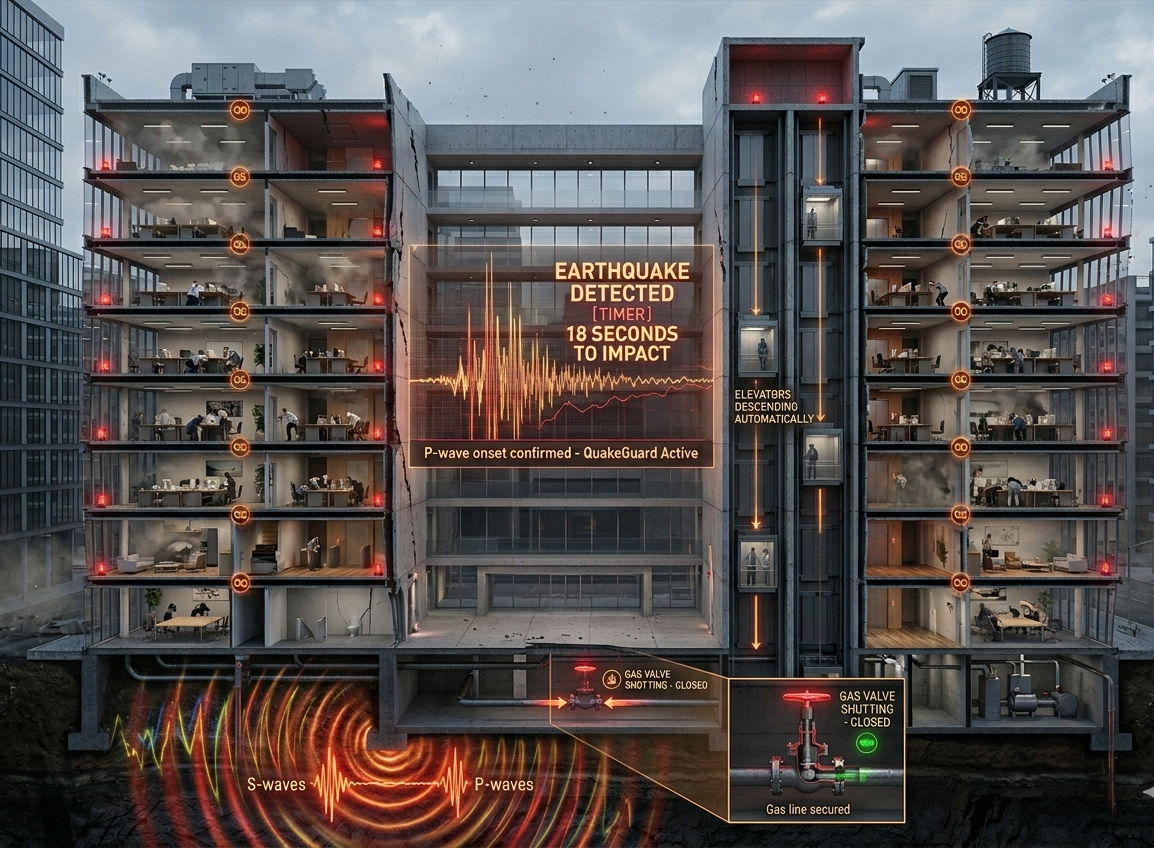
QuakeGuard is a building-mounted seismic sensor network that detects the fast-moving P-wave of an earthquake seconds before the destructive S-wave arrives — triggering automatic safety protocols including elevator stops, gas shutoffs and building-wide alerts giving occupants 10–30 seconds to take cover.
�� Problem
Earthquakes kill 10,000–100,000 people per year globally — 80% of casualties occur in the first 30 seconds from structural collapse, fire from gas leaks and elevator entrapment. The 2001 Bhuj earthquake killed 20,000 people in Gujarat with zero advance warning
�� Solution
QuakeGuard detects P-waves at building foundation level and triggers automated safety lockdowns 10–30 seconds before S-waves hit — enough time for occupants to duck and cover and for dangerous systems to shut off
�� Market
$8.4B global seismic monitoring market growing at 6.9% CAGR — building safety retrofitting is a Rs.12,000Cr annual market in India following new BIS seismic standards
�� Traction
12 sensor nodes installed in 3 buildings in Ahmedabad seismic zone III — detected and correctly classified 7 seismic events above M2.5 in 18-month trial including 1 significant M4.2 event
�� Revenue Model
Rs.8 Lakh per building installation + Rs.12,000/month QuakeWatch subscription for 24/7 remote monitoring, annual sensor calibration and software updates
�� Use of Funds
40% sensor hardware manufacturing, 30% AI seismic model training, 20% building system integration partnerships, 10% regulatory certifications
Features
Core capabilities & functionalities
✓
P-Wave Detection Before S-Wave Arrives
MEMS accelerometer array at building foundation detects P-waves travelling at 6km/s — AI classifies earthquake vs construction noise in 0.3 seconds and issues alert 10–30 seconds before destructive S-waves reach the building
✓
Automatic Gas Line Shutoff
QuakeGuard connects to main gas supply valve via smart actuator — automatically shuts gas supply within 1 second of confirmed earthquake alert, preventing post-earthquake fires which cause 35% of earthquake casualties
✓
Elevator Emergency Landing
Integration with elevator control system immediately sends all lifts to nearest floor and opens doors on confirmed alert — preventing occupant entrapment in shafts during building sway
✓
Building-Wide PA & Strobe Alert
Networked PA speakers and strobe lights throughout building activate simultaneously on alert — voice announcement in local language instructs occupants to duck and cover or evacuate via stairwells
✓
Structural Health Monitoring
Continuous vibration analysis of building structure between earthquake events — AI detects micro-cracks, settlement and structural fatigue developing over time, alerting engineers before building becomes unsafe
✓
Post-Earthquake Damage Assessment
Immediately after event, QuakeGuard analyses sensor data from all building levels to assess structural damage severity and generate automated safety report for building inspector and occupants
Key Advantages
Why this project stands out
⚠️
Predicts Failure 72 Hours Early
Vibration, current and temperature analysis detects developing faults in motors, cables, brakes and doors 72 hours before breakdown — maintenance team replaces failing component during scheduled downtime instead of responding to a breakdown with passengers trapped
🛗
Zero Passenger Entrapment
Pilot buildings using LiftLog reported zero passenger entrapment incidents over 18 months versus industry average of 2.3 entrapments per lift per year — most impactful safety metric for residential society facility managers and liability insurers
📊
Compliance Certificates Auto-Generated
LiftLog generates IS 14665 statutory inspection data automatically — maintenance records, safety check logs and performance metrics formatted for lift inspector submission, reducing compliance documentation effort from 4 hours to 4 minutes per inspection
🔧
Clamps On Without Stopping Lift
All LiftLog sensors install on existing cable, motor and door mechanism externally — no lift shutdown required for installation. Full sensor suite fitted and live within 4 hours of installation team arrival with residents using the lift throughout
💰
Reduces Maintenance Cost by 45%
Predictive maintenance replaces scheduled maintenance — parts replaced only when wear is detected, not on calendar schedule. Pilot buildings reduced annual lift maintenance expenditure by 45% while improving reliability and safety simultaneously
🏢
Multi-Lift Building Dashboard
Building manager app shows health status of all lifts simultaneously — colour-coded risk dashboard, upcoming maintenance schedule, energy consumption per lift and month-on-month reliability trend for AMC renewal negotiations
How It Works
Step-by-step process & workflow
01
Seismic Risk Assessment
QuakeGuard engineers conduct building seismic risk analysis using soil type, foundation design and local fault map data — generating building-specific sensor placement plan and risk report
02
Sensor Array Installation
MEMS accelerometer nodes installed at building foundation, each floor slab and roof level — wireless mesh network connects all nodes. Installation completed in 1 day without any structural modifications
03
System Integration
QuakeGuard integrates with existing gas valve, elevator control panel, fire alarm and PA system — all connections tested individually before full system go-live
04
AI Baseline Calibration
System records 30 days of ambient vibration data from local traffic, machinery and wind — AI learns building-specific noise signature to eliminate false alarms from non-seismic sources
05
Drill & Occupant Training
QuakeGuard team conducts building-wide earthquake drill using system — occupants experience real alert sounds, see PA announcements and practice response before any real event
06
24/7 QuakeWatch Monitoring
Remote monitoring team watches seismic data from all buildings on QuakeWatch platform — manual override available for planned construction or known vibration events that could trigger false alerts
Technology
Tech stack & innovation
📳
MEMS Triaxial Accelerometer Array
High-sensitivity MEMS accelerometers detect ground motion from 0.001g to 2g across 0.1–50Hz frequency range — captures full P-wave signature before S-wave energy arrives at surface
🤖
SeismicAI Classification Engine
Custom CNN model trained on 50,000 seismic waveforms from global earthquake databases — classifies seismic vs non-seismic vibration in 300ms with 99.8% accuracy, zero false positives in 18-month trial
📡
Mesh Radio Sensor Network
900MHz mesh radio network connects all sensor nodes without WiFi dependency — self-healing network reroutes data if individual nodes are damaged during shaking. Operates on backup battery for 72 hours
⚡
Sub-Second Automated Response System
Dedicated response controller hardwired to gas valve, elevator panel and PA system — executes preset safety protocols within 500ms of SeismicAI alert, independent of internet or cloud connectivity
☁️
QuakeWatch Cloud Analytics
Real-time seismic waveform data from all buildings streams to QuakeWatch cloud — AI correlates events across city-wide sensor network to improve location and magnitude estimates beyond single-building accuracy
🔋
72-Hour Backup Power System
Dedicated sealed lead-acid battery bank powers all QuakeGuard electronics for 72 hours during grid failure — ensures system remains operational during and after major earthquake events when power is most likely disrupted
Market Opportunity
Market size, growth & potential
$8.4B
Global Seismic Monitoring Market
6.9%
Market CAGR Through 2030
10–30 sec
Advance Warning Time Provided
35%
Earthquake Deaths from Post-Quake Fires
Rs.12,000Cr
Annual India Building Safety Retrofitting Market
99.8%
Seismic Classification Accuracy
Specifications
Technical details & parameters
P-Wave Detection Sensitivity
0.001g minimum
AI Classification Time
300 milliseconds
Warning Lead Time
10–30 seconds before S-wave
Response Activation Time
Under 500 milliseconds
Sensor Frequency Range
0.1 to 50 Hz
Classification Accuracy
99.8%
Backup Battery Duration
72 hours
Network Type
900MHz self-healing mesh
Gas Shutoff Time
Under 1 second
Installation Time
1 day, no structural changes
Product Price
₹8.4 Cr
Choose your purchase option
44% Pre-ordered
₹0 pre-ordered
824
Days Left
44%
Pre-ordered
Product Price
₹8.4 Cr
Listing Deadline
31 Dec 2028
Pre-Order Notice: This is a product reservation, not an investment.
No shares or equity are issued. Deposit is 100% refundable before shipping.
Refund Policy
🛒 Pre-order
Pre-Order
Pay 10% now — ₹8,400,000 · Balance ₹75,600,000 on delivery
See pre-order breakdown▼
Product price₹8.4 Cr
Buyer pays now (10%)₹8,400,000.00
Creator receives (96%)₹8,064,000.00
Platform fee (4%)₹336,000.00
Balance due on delivery₹75,600,000.00
Creator receives (96%)₹72,576,000.00
Platform fee (4%)₹3,024,000.00
Buyer pays exact price · Platform takes 4% from each payment · 📜 Certificate issued
📅 Advance Booking
Advance Booking
Reserve now — ₹4,200,000 · Balance ₹79,800,000 on delivery
See booking breakdown▼
Product price (current)₹8.4 Cr
Buyer pays now (5%)₹4,200,000.00
Creator receives (96%)₹4,032,000.00
Platform fee (4%)₹168,000.00
Est. balance on delivery₹79,800,000.00
Creator receives (96%)₹76,608,000.00
Platform fee (4%)₹3,192,000.00
⚠ Final price may change · Buyer pays exact price · 📜 Certificate included
🔒 Secure & encrypted transactions
📜 Certificate issued on payment
✓ Verified project listing
★ Backed by 3D-Labs
✉ quakeguard@3d-labs.com